Cooling System Protection
THERMACORE™
Coolant filtration technology for cooling-system cleanliness and component protection.
THERMACORE™ supports cooling-system protection through coolant filtration selected for the approved engine and maintenance requirements.
01 /
Contamination Modes Controlled
Cooling-system particulate contamination
HOW IT WORKS
How THERMACORE™ Works
Engine coolant carries heat from the cylinder liners and head to the radiator, but it also has to protect the metal it touches. Its inhibitors protect against corrosion and, in wet-liner diesel engines, against cavitation erosion: liner vibration creates vapour bubbles on the coolant side that collapse against the metal and, without protection, gradually pit it. At the same time the coolant picks up solid particles (rust, scale, casting residue and corrosion products) that wear the water-pump seal, block the narrow passages of the radiator and coolers, and settle as deposits that reduce heat transfer.
THERMACORE™ protects the cooling system on two fronts. The pleated element holds the particles circulating in the coolant. Where an additive-bearing element is approved for the system, a charge of supplemental coolant additive (SCA) under the element dissolves gradually, replenishing the inhibitors that the coolant consumes in service.
In many engines only part of the coolant flow passes through the filter on each circuit; because the coolant circulates continuously, the whole volume is filtered over time. The figure simplifies this as a single line from the pump through the filter to the water jacket.
The additive side requires care. Its chemistry, release characteristics, thread and seal must match the installed system and the current coolant formulation: too little inhibitor leaves corrosion and cavitation unchecked, while excess or incompatible chemistry can precipitate as deposits. Where an additive-bearing element is not approved for the coolant in use, a filter without additive is used. A filter cannot correct incompatible coolant mixtures, combustion-gas leakage, depleted inhibitors or untreated make-up water, and coolant analysis and the engine maker's requirements take precedence over general schedules.
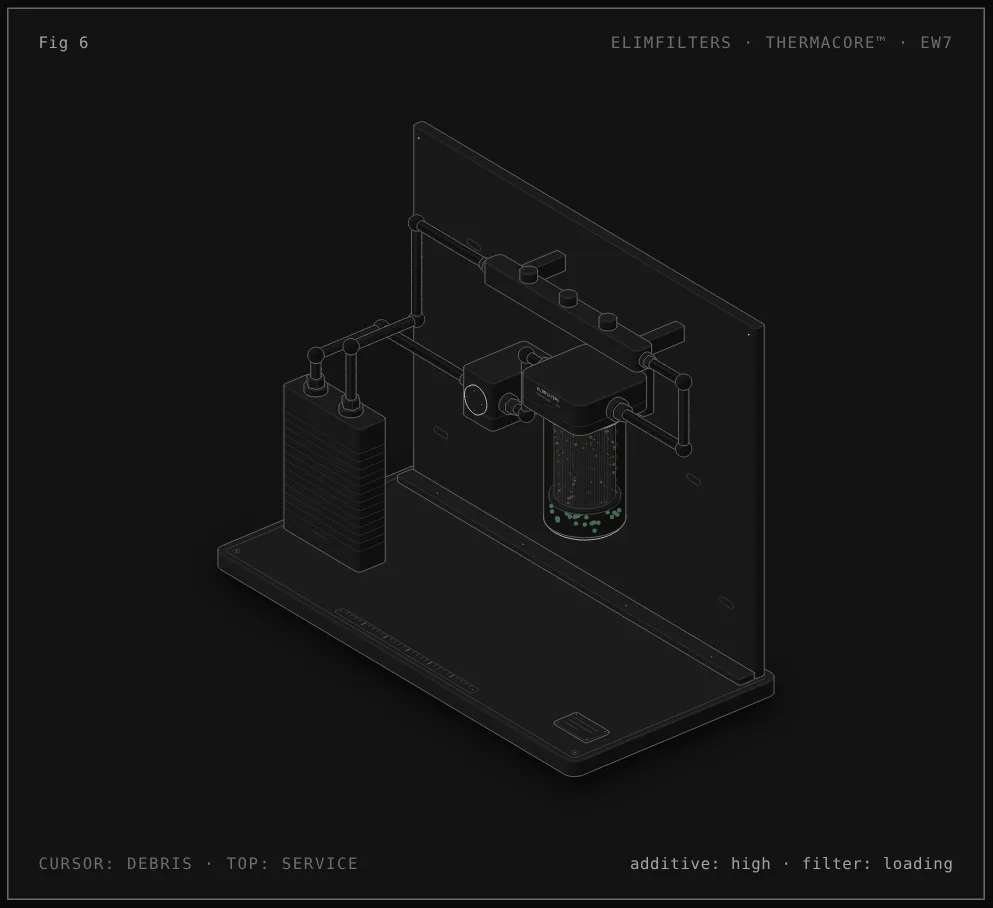
Reading the figure: Coolant spin-on in the cooling circuit
- Radiator. The finned core between two tanks gives up the coolant's heat. Coolant leaves from the top outlet toward the pump and comes back through the return.
- Water pump. Driven by the engine, the pump keeps the coolant circulating through the filter and the engine.
- THERMACORE™ spin-on. Drawn in section, the pleated THERMACORE™ element holds the rust and scale particles. Moving the cursor sideways changes how much debris the coolant carries, and the readout shows the filter's load.
- Additive charge. The blue pellets under the element are the SCA charge, shown for the case where an additive-bearing element is approved. They shrink slowly and release wisps of additive into the coolant; the readout shows the remaining charge.
- Water jacket and cylinder bores. The coolant passes around the cylinders and through the head, where it picks up heat and where the inhibitors protect the liners.
- Return and service. The coolant returns to the radiator. Moving the cursor to the top, or pressing E, runs the service: the spin-on is replaced and the new one goes on clean, with a full additive charge.
What each component does
- Pleated THERMACORE™ element
- The filtration media that holds rust, scale and other particles circulating in the coolant before they deposit in the radiator, coolers and engine passages.
- SCA additive charge (where an additive-bearing element is approved)
- A charge of supplemental coolant additive under the element that dissolves gradually, replenishing the inhibitors that protect against corrosion and liner cavitation. Its chemistry must match the coolant in use.
- Filter head
- The fixed mount on the engine with the inlet, the outlet and the sealing face. Where the design includes shut-off valves (not drawn), the filter can be changed without draining the system.
- Water pump
- Keeps the coolant circulating; its shaft seal is one of the components most exposed to abrasive particles.
- Water jacket and cylinder liners
- Where the coolant picks up heat. On wet liners, the coolant side is where cavitation erosion acts if the inhibitors are depleted.
- Radiator and return
- The radiator rejects the heat; its narrow tubes are among the first passages to block with debris and deposits.
Service sequence
- Let the engine cool. Never open a hot, pressurized cooling system.
- Confirm that the replacement is the THERMACORE™ element approved for that engine and for the coolant in use, with or without additive as the system requires, with the correct thread and seal.
- Close the shut-off valves if the head has them, unscrew the filter, check that the old gasket came off with it, clean the sealing face, lubricate the new gasket with coolant and tighten as specified. Open the valves again.
- Top up only with the approved coolant at the correct mix, and never mix incompatible coolants or add untreated water.
- Run the engine, bleed the air as the engine procedure specifies and check for leaks; check the level again with the engine cold.
- Check the coolant condition (inhibitor level and analysis) as the maintenance program specifies, especially after overheating, component replacement or coolant mixing.
Diagnosis in the circuit
The filter loads quickly with rust and scale
Corrosion is active somewhere in the system. Analyse the coolant for depleted inhibitors, incompatible mixtures or untreated make-up water before changing the filtration strategy.
Gel, sludge or a crystalline deposit on the element
Distinguish chemical precipitation from suspended debris: excess additive, an incompatible additive or mixed coolants can drop out of solution. The filter is showing a chemistry problem.
Traces of oil or fuel in the coolant
External contamination, for example from a cooler or a gasket. The filter cannot correct it; the leak path has to be found and repaired.
Bubbles, pressure rise or coolant loss
Possible combustion-gas leakage into the cooling system. It is a mechanical fault that filtration does not solve.
Liner pitting found at overhaul
Cavitation protection was insufficient. Review the inhibitor maintenance, the coolant analysis history and whether the additive chemistry matched the coolant.
02 /
Application Selection
Cooling-system filtration must be evaluated together with coolant specification, chemical condition, water quality, corrosion products, scale, system volume and the engine maker's maintenance practice. The filter cannot correct incompatible coolant mixtures, active combustion-gas leakage, depleted inhibitors or untreated make-up water. Diagnosis should therefore distinguish suspended debris from chemical precipitation, corrosion and external contamination before changing the filtration strategy. Where a coolant filter or additive-bearing element is approved, its chemistry, thread, seal and release characteristics must match the installed system and the current coolant formulation.
Evidence Boundary
THERMACORE™ describes approved cooling-system protection architecture; it does not establish one filtration efficiency, additive charge or replacement interval for every engine. Quantitative claims and chemical compatibility must be supported by the individual product, coolant and application evidence. Equipment-manufacturer requirements and coolant analysis take precedence over generalized schedules, especially after overheating, component replacement or coolant mixing.
02 /