Fuel Cleanliness Protection
SYNTAPORE™
Diesel-fuel filtration architecture for primary, secondary and cartridge filter applications.
SYNTAPORE™ is the ELIMFILTERS diesel-fuel filtration architecture developed for primary, secondary and cartridge filter applications. It supports staged particulate control before fuel reaches high-pressure pumps, injectors and other precision components. The architecture allows each filtration position to be matched to the required efficiency, contaminant capacity, fuel flow and pressure-drop conditions. This application-specific approach supports reliable fuel-system protection across different engines, operating environments and service strategies. Product-level performance and service intervals are validated individually according to the filter, application and applicable test requirements.
01 /
Contamination Modes Controlled
Fuel particulate contamination
HOW IT WORKS
How SYNTAPORE™ Works
Diesel fuel reaches the engine carrying hard particulate picked up during refining, storage, transfer and refuelling, and from the tank itself. The injection system (transfer pump, high-pressure pump and injectors) works with close internal clearances and relies on the fuel itself for lubrication, so particles that get past filtration act as an abrasive on exactly those surfaces. SYNTAPORE™ is the ELIMFILTERS architecture that controls this particulate before it reaches the injection system.
Instead of asking one filter to do everything, SYNTAPORE™ works in stages. The primary filter sits on the suction side, between the tank and the transfer pump. It holds the larger particles and the bulk of the contaminant load, protecting the transfer pump and keeping that load away from the next stage. Because it works under suction, its restriction has to stay low: a restricted suction-side filter can starve the pump of fuel.
The secondary filter sits on the pressure side, after the transfer pump and before the injection system. With the larger particles already held by the primary, it is configured to hold the finer particles the injection system is most sensitive to. Each position is matched individually to fuel flow, contaminant load and allowable pressure drop, which is why a primary and a secondary element are not interchangeable even when they look alike.
SYNTAPORE™ governs particulate filtration only. Where a position also has to separate water from the fuel, that function belongs to HYDROCORE™ (standard separators) or TURBOCORE™ (FH and FG turbine-style systems). The figures below show plain particulate filters.
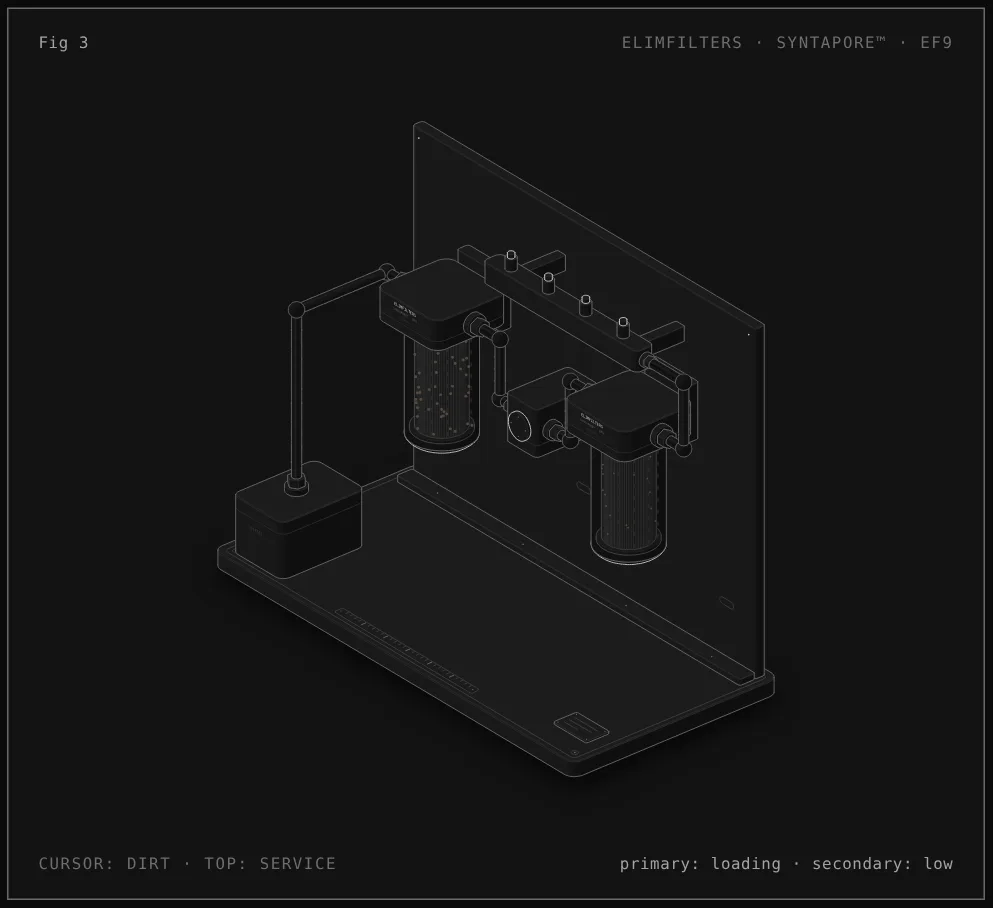
Reading the figure: Primary and secondary filters in the fuel circuit
- Tank. Fuel leaves the tank through the suction line. The dark dots in the fuel represent the particulate it carries; moving the cursor sideways changes how much.
- Primary spin-on, suction side. The transfer pump draws the fuel through the first pleated SYNTAPORE™ element. The larger particles stay on the pleats, so this is the filter that takes most of the contaminant load.
- Transfer pump. The pump receives fuel that no longer carries the larger particles and sends it, now under pressure, toward the engine.
- Secondary spin-on, pressure side. The fuel crosses a second pleated SYNTAPORE™ element, which holds the finer particles. It is the last filtration stage before the injection system.
- Injection rail and injectors. The rail distributes the fuel to the four injectors: the components both stages exist to protect.
- Service. Moving the cursor to the top of the figure, or pressing E, runs the service: both spin-ons come off their heads and new ones are fitted. Heads, lines and pump stay on the equipment.
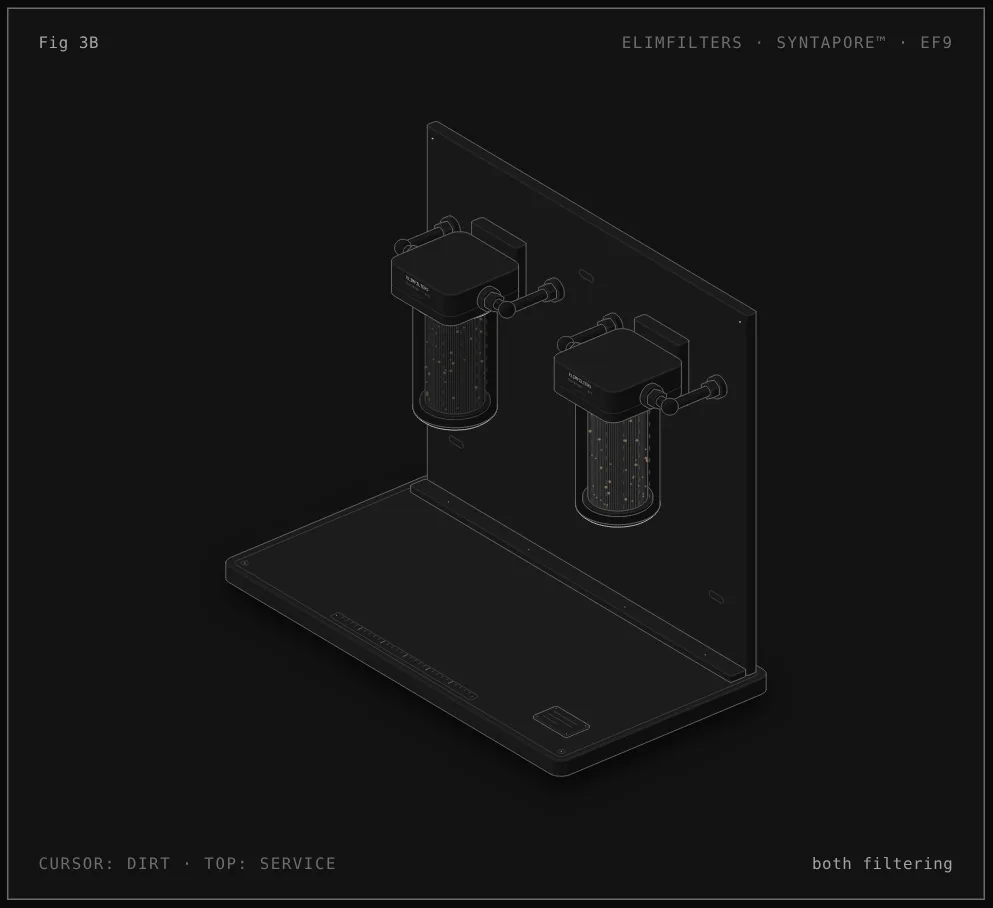
Reading the figure: Spin-on and cartridge formats
- Heads on the bracket. Both filters hang from a fixed head with an inlet and an outlet port. The head belongs to the equipment and is never replaced at service.
- Left: spin-on. The pleated SYNTAPORE™ element is sealed inside its own can, which screws onto the head.
- Right: cartridge. A permanent bowl closes against the head and holds a pleated SYNTAPORE™ element that is replaced on its own.
- Flow. In both formats the fuel enters through the head, crosses the pleated media, where the particles are held, and leaves through the head toward the next component. The filtration principle is the same.
- Service. Moving the cursor to the top, or pressing E, runs the service: the spin-on comes off whole, can included; on the cartridge the bowl drops, the element is changed and the same bowl goes back.
What each component does
- Pleated SYNTAPORE™ element
- The filtration media, folded into pleats so a large media area fits in a compact element. It holds the particles and lets the fuel through; its configuration is what differs between a primary and a secondary position.
- Filter head
- The fixed part on the engine or bracket. It carries the inlet and outlet ports and the sealing face the spin-on or the bowl seals against. It is not replaced at service.
- Spin-on can
- A sealed metal can that contains the element and screws onto the head. Element, can and gasket are replaced together.
- Cartridge bowl
- In the cartridge format, the reusable housing around the element. It comes off at service and is refitted with the new element and its new seals.
- Transfer pump
- Draws the fuel from the tank through the primary and delivers it under pressure through the secondary. It is the component the primary protects directly.
- Injection rail and injectors
- Deliver the fuel into the engine. They are the most sensitive components in the circuit and the reason the secondary stage exists.
Spin-on and cartridge formats
Spin-on. The element is built into its own sealed can. Service is quick and closed: the whole unit is unscrewed and a new one is screwed on, so the head's sealing face and the new gasket are the only interfaces to check. The complete can is discarded.
Cartridge. The housing is a permanent part of the equipment and only the element is replaced, which reduces the material discarded at each service. It also puts more responsibility on the technician: the bowl and housing must be clean and undamaged, and the seals supplied with the element must be fitted, because a poorly seated element lets fuel bypass the media.
Which one applies. The format is set by the engine or equipment design; the filtration principle is the same in both. The replacement is chosen by its position and approved housing, never by external dimensions alone.
Service sequence
- Identify the position (primary, secondary or cartridge) and confirm the replacement is the element approved for that position and housing.
- Spin-on: unscrew the filter, check that the old gasket came off with it, clean the head's sealing face, lubricate the new gasket with clean fuel and tighten as the equipment maker specifies.
- Cartridge: remove the bowl and the used element, clean the bowl, fit the new element with the new seals supplied with it and refit the bowl.
- Bleed the air from the fuel system with the procedure the engine maker specifies. Do not fill a secondary filter with unfiltered fuel: that fuel would go straight to the injection system.
- Start the engine and check every filter and connection for leaks. On the suction side a poor seal may draw in air instead of leaking fuel.
Diagnosis in the circuit
The primary restricts sooner than expected
Look upstream first: tank contamination, storage and transfer practices, or a poor fuel batch. The primary reports what the fuel carries; shortening the interval without finding the source only treats the symptom.
Restriction appears in cold weather and clears when warm
Consider low-temperature waxing of the fuel on the media before treating it as dirt loading. Fuel grade and cold-weather practice are part of the diagnosis.
The secondary loads faster than the primary
The primary may not be holding its share: check for an incorrect element in the primary position, a damaged seal or a bypass around the media, then the line between the two stages.
Hard starting or loss of power after service
Look for air in the circuit: incomplete bleeding or a suction-side seal drawing air. Confirm the correct element was fitted in each position.
Water in the fuel or in the filters
Water separation is outside SYNTAPORE™ scope. Review the water-separation stage and the upstream storage; a particulate filter is not built to manage free water.
02 /
Application Selection
Selection starts by identifying whether the element serves a primary, secondary or cartridge position, then matching fuel flow, injection-system sensitivity, contaminant load, cold-flow behavior and allowable restriction. The complete fuel path should be reviewed for storage contamination, transfer practices and upstream water management because a final filter cannot correct every source condition by itself. Seal materials, connections and bypass behavior must match the approved housing. When restriction rises prematurely, diagnosis should distinguish abnormal contamination, fuel quality, low-temperature waxing and an incorrect element before changing the maintenance interval.
Evidence Boundary
SYNTAPORE™ does not create a universal micron rating, efficiency, capacity or service life for every diesel filter. Quantitative claims require product-level evidence under the applicable test method and the approved application. HYDROCORE™ remains the architecture for standard non-turbine water separators, while TURBOCORE™ is reserved for approved FH and FG turbine-style systems; those scopes must not be merged.
02 /
Protection Systems
COMPLEMENTARY TECHNOLOGIES