Lubrication Protection
SYNTRAX™
Lubrication-filtration architecture for wear debris, soot agglomerates and oil contaminant control.
SYNTRAX™ is the ELIMFILTERS lubrication-filtration architecture designed to control wear debris, soot agglomerates and other contaminants circulating within engine oil. Its engineering approach balances filtration performance, contaminant capacity, oil flow, pressure drop and valve integrity throughout changing temperatures and operating conditions. This enables the filter configuration to be selected according to engine duty, lubricant condition and the established maintenance program. Performance and service capacity are determined for each product and application rather than assigned as universal values to the complete technology.
01 /
Contamination Modes Controlled
Lubricant particulate contamination
HOW IT WORKS
How SYNTRAX™ Works
Engine oil lubricates, cools and also carries away what the engine generates: wear particles from bearings, rings and the valve train, soot from combustion that reaches the crankcase, and dust that got past the air intake. The lubricated surfaces are separated by a very thin oil film, so particles of a similar size act as an abrasive every time they pass through. SYNTRAX™ is the ELIMFILTERS lubrication-filtration architecture that controls this wear debris and the soot agglomerates circulating in the oil.
In a full-flow circuit the oil pump draws oil from the pan and sends all of it through the filter before it reaches the main gallery that feeds the bearings. Every bearing therefore receives oil that has just been filtered. The oil then drains back to the pan and the cycle repeats continuously while the engine runs.
Because all the oil passes through it, the filter has to balance two duties: holding contaminants and letting enough oil through. Oil is far thicker at a cold start than at operating temperature, and the engine must never be starved. That is why lube filters work with a bypass valve, which opens when the pressure difference across the element becomes too high (cold oil or a heavily loaded element) and lets oil reach the bearings, and often with an anti-drainback valve that keeps the filter full when the engine stops, so pressure builds quickly at the next start.
Selection therefore depends on oil viscosity across start-up and operating temperature, engine flow demand, bypass behaviour, how much contamination the engine generates and the oil-drain strategy. Performance and service capacity belong to each product and application, never to the technology as a single universal value.
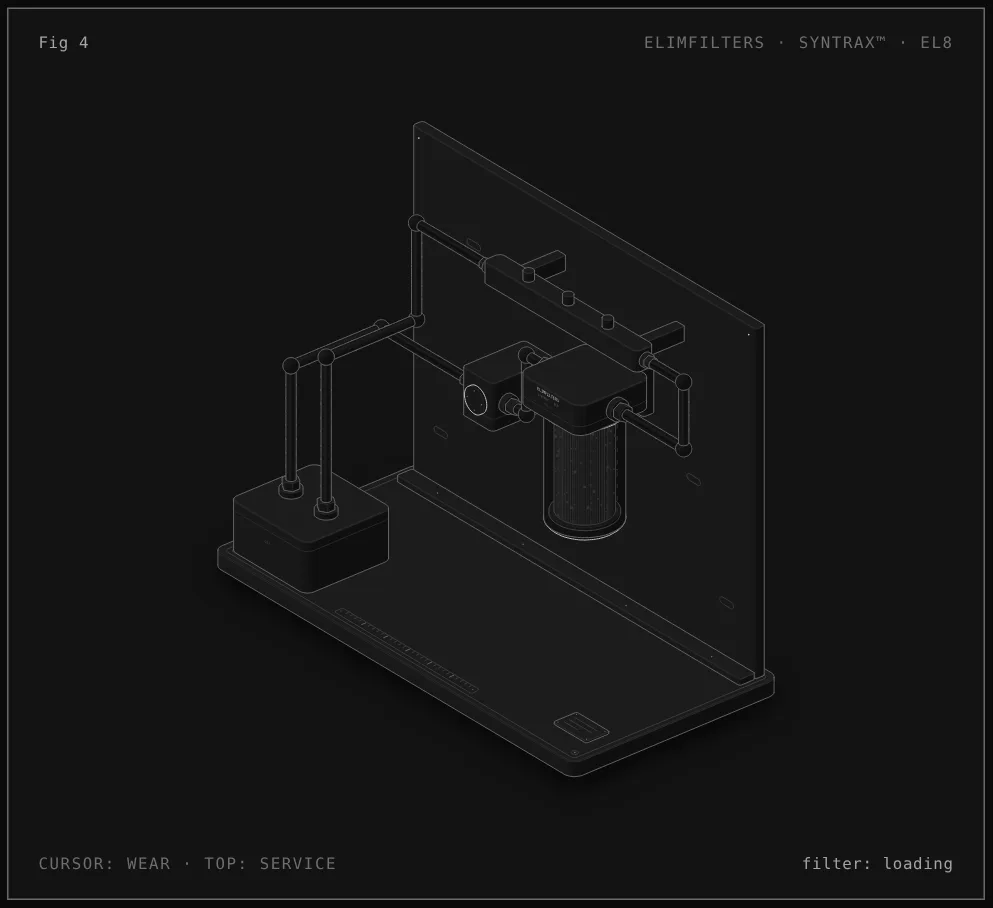
Reading the figure: Full-flow spin-on in the lube circuit
- Oil pan and pickup. The oil rests in the pan on the bench. The pickup line draws it from the pan to the pump.
- Oil pump. Driven by the engine, the pump sends the oil under pressure to the filter head.
- SYNTRAX™ full-flow spin-on. All the oil crosses the pleated SYNTRAX™ element, drawn in section. The larger dots are wear particles and the finer ones soot; moving the cursor sideways changes how much the oil carries, and the readout shows the filter's load.
- Main gallery and bearing feeds. From the filter the oil reaches the main gallery, which distributes it to the bearings through the feeds.
- Return. After lubricating, the oil drains back to the pan through the return line and the circuit starts again.
- Service. Moving the cursor to the top, or pressing E, runs the service: the spin-on is replaced and the new one goes on clean. Head, pump and gallery stay on the engine.
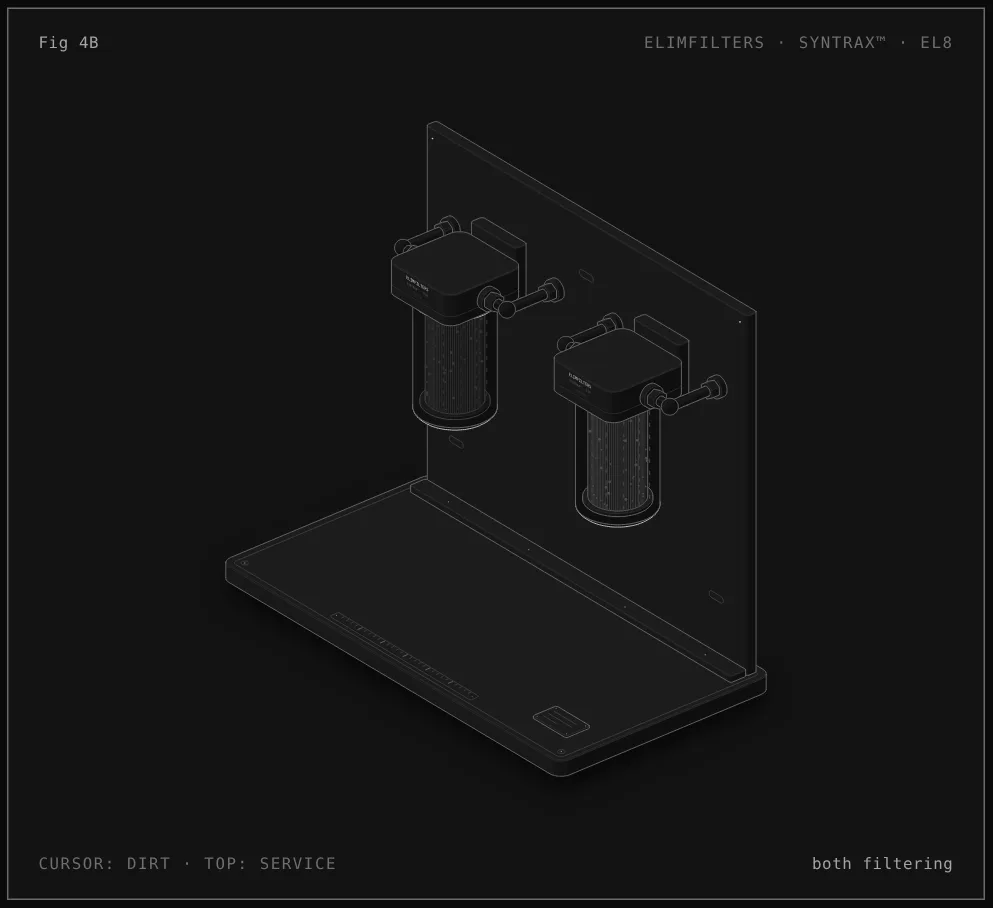
Reading the figure: Spin-on and cartridge formats
- Heads on the bracket. Both filters hang from a fixed head with an inlet and an outlet port. The head belongs to the engine and is never replaced at service.
- Left: spin-on. The pleated SYNTRAX™ element is sealed inside its own can, which screws onto the head.
- Right: cartridge. A permanent bowl closes against the head and holds a pleated SYNTRAX™ element that is replaced on its own.
- Flow. In both formats the oil enters through the head, crosses the pleated media, where wear particles and soot are held, and leaves through the head toward the gallery. The filtration principle is the same.
- Service. Moving the cursor to the top, or pressing E, runs the service: the spin-on comes off whole, can included; on the cartridge the bowl drops, the element is changed and the same bowl goes back.
What each component does
- Pleated SYNTRAX™ element
- The filtration media, folded into pleats so a large media area fits in a compact element. It holds wear particles and soot agglomerates while letting the full oil flow through.
- Filter head
- The fixed mount on the engine block with the inlet from the pump and the outlet to the gallery, and the sealing face the filter seals against. It is not replaced at service.
- Spin-on can
- A sealed metal can that contains the element and screws onto the head. Element, can and gasket are replaced together.
- Cartridge bowl
- In the cartridge format, the reusable housing around the element. It comes off at service and is refitted with the new element and its new seals.
- Oil pump
- Draws oil from the pan through the pickup and delivers it under pressure through the filter to the gallery.
- Main gallery and bearing feeds
- Distribute the filtered oil to the bearings. They are the components the filter exists to protect.
- Oil pan, pickup and return
- The pan holds the oil; the pickup takes it to the pump and the return brings it back after lubricating.
- Bypass valve (inside the filter or head, not drawn)
- Opens when the pressure difference across the element is too high, as with cold oil or a heavily loaded element, so the bearings are never left without oil. Its setting belongs to the approved filter and engine.
- Anti-drainback valve (inside the filter, where fitted, not drawn)
- Keeps the oil in the filter when the engine stops, so oil pressure builds quickly at the next start.
Spin-on and cartridge formats
Spin-on. The element is built into its own sealed can. Service is quick and closed: the whole unit is unscrewed and a new one is screwed on, so the head's sealing face and the new gasket are the only interfaces to check. The complete can is discarded.
Cartridge. The housing is a permanent part of the engine and only the element is replaced, which reduces the material discarded at each service. It also puts more responsibility on the technician: the housing must be clean and undamaged, and the seals supplied with the element must be fitted, because a poorly seated element lets oil bypass the media.
Which one applies. The format is set by the engine design; the filtration principle is the same in both. The replacement is chosen as the element approved for that engine and housing, including its bypass and anti-drainback behaviour, never by external dimensions alone.
Service sequence
- Confirm that the replacement is the SYNTRAX™ element approved for that engine and format; fit, gasket compression and valve functions are part of the protected circuit.
- Change the filter together with the oil, following the engine's maintenance program and the oil-drain procedure.
- Spin-on: unscrew the filter, check that the old gasket came off with it, clean the head's sealing face, lubricate the new gasket with clean engine oil and tighten as the engine maker specifies.
- Cartridge: remove the bowl and the used element, clean the housing, fit the new element with the new seals supplied with it and refit the bowl as specified.
- Refill with the specified oil, start the engine and confirm that oil pressure comes up promptly. Check the filter for leaks, then stop the engine and recheck the oil level.
Diagnosis in the circuit
The filter loads much sooner than expected
Review combustion condition (soot), coolant or fuel dilution, air-intake sealing and the oil-sampling history before moving to a different element. The filter reports what the engine generates.
Slow oil-pressure build-up or noise at cold start
Check that the correct element is fitted, with its anti-drainback function, and that the oil viscosity suits the start-up temperature.
Low oil pressure with a filter that looks fine
Check for an incorrect element or a bypass that is not behaving as designed, then the pump and pickup side of the circuit.
Oil leak at the filter after service
Look for a double gasket (the old one left on the head), a damaged gasket or incorrect tightening.
Oil analysis shows rising dust or wear indicators
Check the air-intake sealing and the wear sources, and make sure samples are taken consistently and compared with engine-specific limits.
02 /
Application Selection
Lubrication filtration selection must account for oil viscosity across startup and operating temperature, engine flow demand, bypass-valve behavior, contaminant generation and the established oil-drain strategy. The element must control wear debris and soot agglomerates without starving lubricated components during cold starts or high-flow operation. Recurring short intervals should trigger review of combustion condition, coolant or fuel dilution, air-intake sealing and sampling history rather than an automatic move to a different nominal rating. Fit, gasket compression, anti-drainback function and housing condition remain part of the protected lubrication circuit.
Evidence Boundary
SYNTRAX™ defines lubrication-filtration architecture, not one micron rating, capacity, bypass setting or oil-drain interval for all engines. Product performance belongs to the individual filter and approved application. Oil analysis can support condition assessment, but interpretation must use consistent sampling and engine-specific limits; it does not replace verified fit, pressure-flow requirements or manufacturer service guidance.
02 /