Air Intake & Airflow Protection
DRYCORE™
Air-dryer filtration technology for pneumatic brake-system protection.
DRYCORE™ controls moisture in compressed-air circuits to support pneumatic brake-system reliability.
01 /
Contamination Modes Controlled
Moisture in compressed air
HOW IT WORKS
How DRYCORE™ Works
An air compressor draws in ambient air together with its water vapour. Compression concentrates that moisture, and as the compressed air cools in the lines, reservoirs and valves, the water condenses. Water in a pneumatic brake system corrodes reservoirs and valve bodies, washes out lubricant, makes valves stick and, in cold weather, can freeze in lines and valves. Oil carried over from the compressor adds to the contamination. DRYCORE™ controls moisture in compressed-air circuits to support pneumatic brake-system reliability.
The cartridge holds a desiccant bed: a mass of adsorbent beads that takes up water vapour from the compressed air flowing through it, so the air that reaches the reservoir is dry. The bed can only hold a limited amount of moisture, so it has to be regenerated regularly.
Regeneration happens on the purge cycle. When the system reaches its operating pressure and the compressor unloads, the purge valve under the cartridge opens and dry air flows back through the bed, carrying the collected moisture out through the valve to the atmosphere. The bed is then ready for the next loading cycle. That is why the cartridge's life depends on the purge working correctly, on the compressor's duty and cycling, and on how much oil reaches it: oil coats the desiccant and reduces its ability to take up water.
Diagnosis therefore has to separate normal condensate management from a failed purge valve, saturated desiccant, oil carryover, air leakage or excessive compressor cycling. DRYCORE™ does not promise one dew point, oil-removal efficiency or service interval across all vehicles and climates, and final service decisions follow the equipment maker's safety requirements.
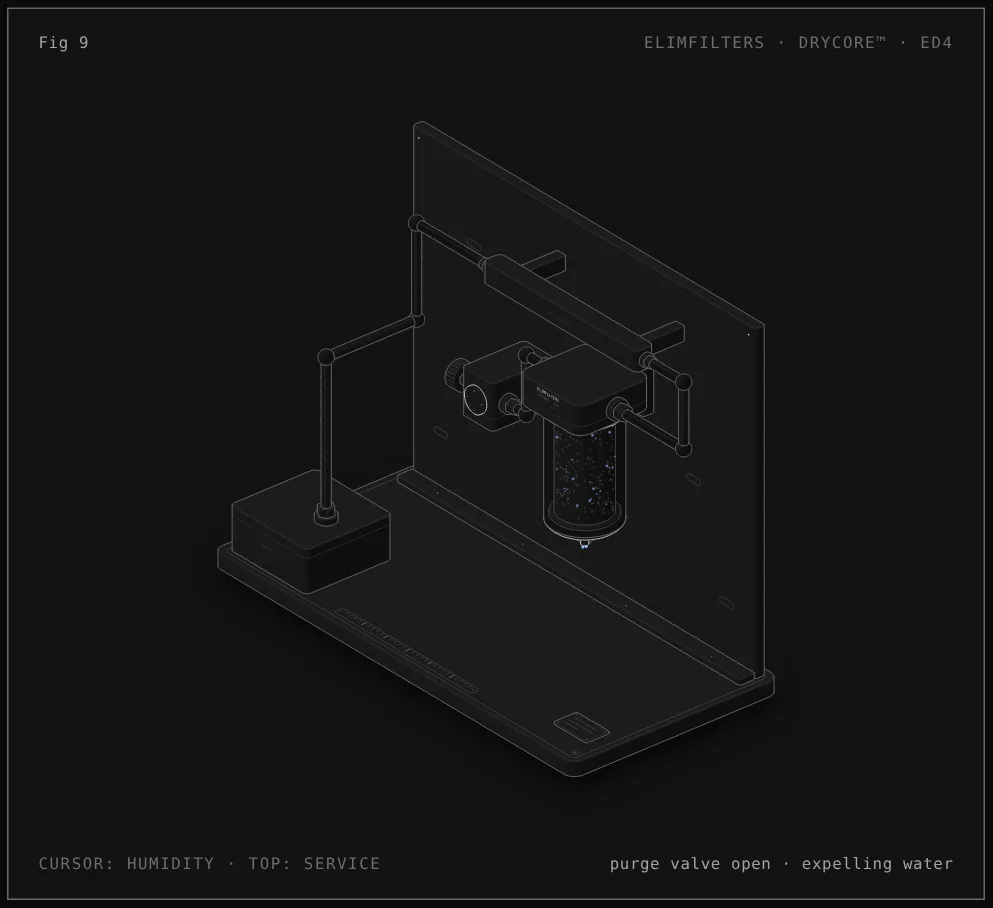
Reading the figure: Desiccant cartridge in the brake air circuit
- Compressor and intake. The compressor draws ambient air through its intake and delivers it under pressure toward the dryer. Moving the cursor sideways changes how much moisture the air carries.
- DRYCORE™ cartridge in section. The compressed air flows through the desiccant bed inside the cartridge, which takes up the water vapour.
- Moisture in the bed. The blue marks show the moisture held by the front of the bed. The readout goes from dry to taking up moisture and to near saturation as the bed loads.
- Purge valve. On the purge cycle, the purge valve under the cartridge opens and the collected water drops out; part of the bed's capacity is recovered. The readout shows when the valve is open.
- Air reservoir. The dry air is stored in the reservoir, ready for the brake system.
- Brake valves. From the reservoir, the air supplies the brake-valve block, the components the dryer exists to protect.
- Service. Moving the cursor to the top, or pressing E, runs the service: the cartridge comes off and a new one goes on with a dry desiccant bed.
What each component does
- Desiccant bed
- The adsorbent beads that take up water vapour from the compressed air. Their capacity is limited and is recovered on each purge cycle.
- DRYCORE™ cartridge and head
- The cartridge holds the desiccant and seals against the dryer head, which stays on the vehicle. Thread and seal must match the installed dryer.
- Purge valve
- Opens on the purge cycle so the backflow of dry air can carry the collected water out. A valve that does not open, or does not close, defeats the dryer.
- Heater (where fitted, not drawn)
- Keeps the purge area from freezing in cold weather.
- Compressor and intake
- Produce the compressed air. A dirty intake, a hot compressor or oil carryover all increase the load on the cartridge.
- Governor (not drawn)
- Controls when the compressor loads and unloads, and so when the purge cycle happens.
- Air reservoir
- Stores the dry air; any water that collects here is a symptom to investigate.
- Brake valves
- The components that rely on clean, dry air to operate correctly.
Service sequence
- Park the vehicle safely, secure it against moving and follow the equipment maker's procedure. Release all the air pressure in the system before removing the cartridge: compressed air stores energy and can cause injury.
- Confirm that the replacement is the DRYCORE™ cartridge approved for that dryer, with the correct thread, seal and service procedure.
- Remove the used cartridge, clean the sealing face of the head, prepare the new seal as specified and fit the new cartridge, tightening it as the maker specifies.
- Restart, build up pressure and check for leaks. Confirm that the purge valve exhausts when the compressor unloads.
- After a period in service, drain the reservoirs and check for water or oil to confirm the system is working.
- If water keeps appearing downstream, inspect the compressor, governor, heater, purge cycle and reservoirs before fitting another cartridge.
Diagnosis in the circuit
Water in the reservoirs
Check that the purge valve opens on every cycle, whether the desiccant is saturated, whether the compressor runs hot or works too long, and whether leaks keep it running.
Oil in the reservoirs or on the cartridge
Oil carryover from the compressor. It contaminates the desiccant and shortens its life; the compressor has to be addressed, not only the cartridge.
The purge valve hisses or leaks continuously
The valve is not seating: debris, wear or a fault in the valve. The bed cannot be regenerated correctly while it leaks.
The compressor cycles too often
Look for air leaks downstream and check the governor. Frequent cycling leaves less time for regeneration and increases the moisture load.
Lines or valves freeze in cold weather
Water is getting past the dryer, or the heater (where fitted) is not working. Find the source before the next cold period.
02 /
Application Selection
Air-dryer protection must be matched to compressor duty, purge behavior, reservoir layout, ambient temperature, humidity and the pneumatic system's actual moisture load. Diagnosis should distinguish normal condensate management from a failed purge valve, saturated desiccant, oil carryover, air leakage or excessive compressor cycling. The filter and desiccant assembly must also be compatible with the installed cartridge interface and service procedure. In brake applications, recurring water downstream of the dryer is a system symptom that warrants inspection of the compressor, governor, heater, purge cycle and reservoirs before another cartridge is fitted.
Evidence Boundary
DRYCORE™ describes moisture-control architecture for approved compressed-air and pneumatic applications; it does not promise one dew point, oil-removal efficiency or service interval across all vehicles and climates. Any quantitative performance claim belongs to a validated cartridge and test condition. Final service decisions must follow the equipment manufacturer's safety requirements, the installed dryer design and verified application data.
02 /