01 / Fine aerosol and small-droplet capture within fibrous or porous coalescing media
This mechanism is evaluated together with the operating envelope, contamination load, compatibility and required treatment outcome.
FILTRATION TECHNOLOGY
Gas Coalescence
Fine liquid-aerosol and entrained-droplet coalescence for natural-gas and industrial process-gas streams where downstream equipment requires controlled liquid carryover.
Capture fine liquid aerosols and small entrained droplets within coalescing media, promote droplet growth, and provide a reliable drainage path so separated liquid leaves the gas stream before sensitive downstream equipment.
DESCRIPTION
Capture fine liquid aerosols and small entrained droplets within coalescing media, promote droplet growth, and provide a reliable drainage path so separated liquid leaves the gas stream before sensitive downstream equipment.
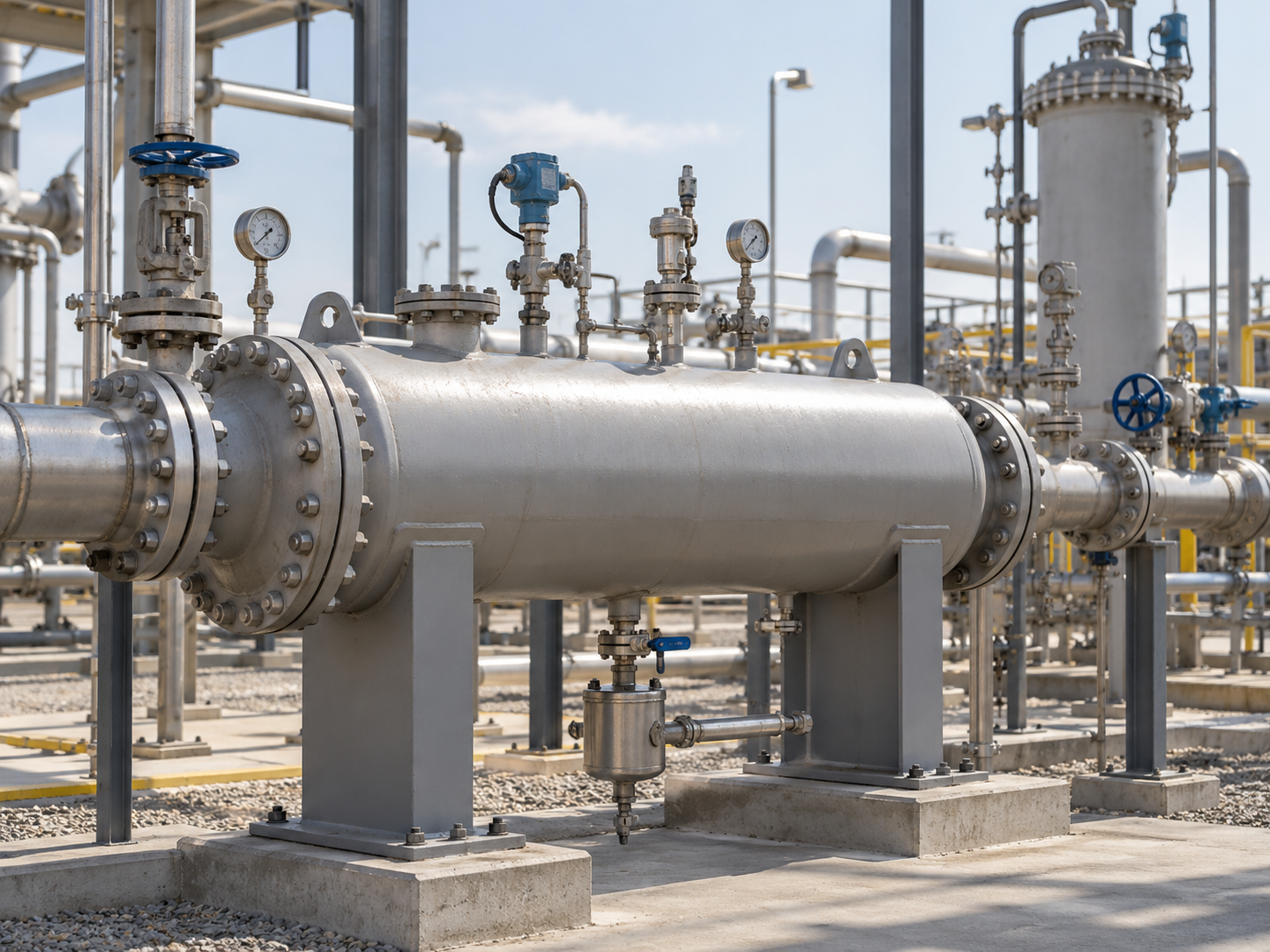
This mechanism is evaluated together with the operating envelope, contamination load, compatibility and required treatment outcome.
This mechanism is evaluated together with the operating envelope, contamination load, compatibility and required treatment outcome.
This mechanism is evaluated together with the operating envelope, contamination load, compatibility and required treatment outcome.
This mechanism is evaluated together with the operating envelope, contamination load, compatibility and required treatment outcome.
This mechanism is evaluated together with the operating envelope, contamination load, compatibility and required treatment outcome.
OPERATING REALITY
The filter, element, media, vessel or treatment device is only one part of the result. Flow, contaminant loading, pressure, temperature, chemistry, housing condition, drainage, sealing and upstream/downstream process behavior can materially change performance.
COALERIS™ identifies a treatment function. It does not make every product or system inside that category technically interchangeable.
Efficiency, capacity, pressure drop, outlet quality, service interval and compatibility remain tied to validated product or project evidence.
ELIMFILTERS PRODUCT SCOPE
For this Industrial & Process family, the ELIMFILTERS commercial focus is the validated filtration, separation or treatment medium and replaceable element appropriate to the application. Existing housings, vessels, collectors, skids, pumps, fans, ductwork, controls and other plant equipment define interfaces and operating conditions; they are not presented as ELIMFILTERS-manufactured equipment unless separately approved.
APPLICATION ENVIRONMENT
SPECIFICATION & SELECTION
Known project conditions? Send the operating data. Uncertain process or treatment path? Use the engineering review.
HOW THE SYSTEM BEHAVES
Capture fine liquid aerosols and small entrained droplets within coalescing media, promote droplet growth, and provide a reliable drainage path so separated liquid leaves the gas stream before sensitive downstream equipment.
Final design depends on the project operating window and the validated configuration selected for the application.
Final design depends on the project operating window and the validated configuration selected for the application.
Final design depends on the project operating window and the validated configuration selected for the application.
Final design depends on the project operating window and the validated configuration selected for the application.
Final design depends on the project operating window and the validated configuration selected for the application.
The objective is controlled contamination or conditioning performance at the required process boundary—not simply installation of a familiar filter form.
ENGINEERING GUIDANCE
COALERIS™ is selected when the gas stream carries fine liquid aerosols or small droplets that are not reliably removed by gravity or bulk separation alone. The media captures droplets and promotes their growth so they can leave the gas stream through the drainage path.
Free liquid, large droplets and slugs can impose a very different load from fine aerosol. Where the incoming liquid challenge exceeds the validated coalescing duty, an upstream bulk-separation stage may be required before COALERIS™.
Captured liquid must leave the coalescing stage. Restricted drainage, flooding or liquid accumulation can increase differential pressure and promote re-entrainment even when the media itself is appropriate.
Gas flow, local velocity and turndown influence droplet transport, residence and re-entrainment risk. Element count, vessel configuration and operating envelope therefore belong to the application assessment rather than a universal family claim.
Pressure, temperature, gas composition, aerosol loading, liquid properties and upstream solids can change media loading, drainage, differential pressure and service behavior. Selection cannot be reduced to element dimensions or a cross-reference alone.
Protecting compressors, turbines, fuel-gas equipment or downstream gas-treatment stages can require different allowable carryover and operating margins. The target condition must be defined before the coalescing element is selected.
COALERIS™ identifies the ELIMFILTERS coalescing element family. Pressure vessels, separators, drains, level controls, instrumentation and piping remain system equipment unless separately specified.
SERVICE & DIAGNOSIS
Repeated breakthrough, pressure-drop problems, unstable outlet quality or short service intervals justify reviewing the whole process boundary.
REQUEST PROCESS REVIEWQUESTIONS FROM THE FIELD
COALERIS™ is the ELIMFILTERS Industrial & Process technology for gas coalescence. Its role is to capture fine liquid aerosols and small entrained droplets within coalescing media, promote droplet growth, and provide a reliable drainage path so separated liquid leaves the gas stream before sensitive downstream equipment.
COALERIS™ belongs to COALVEX™ — Gas Conditioning Technologies. The platform defines the commercial treatment universe while the family identifies the specific mechanism or treatment function.
No. Industrial & Process selection starts with the operating problem, process conditions, contaminant, flow, pressure, temperature, compatibility requirements and required outcome. Product configuration follows the validated application.
No universal performance value is assigned across the family. Numeric efficiency, capacity, pressure-drop, service-life or outlet-quality claims must remain tied to validated product or project evidence.
No. ELIMFILTERS Industrial & Process is centered on the validated filtration, separation or treatment media and replacement element. Housings, vessels, collectors, skids, pumps, fans, ductwork, controls and other process equipment are application context unless a separate ELIMFILTERS system scope is explicitly approved.
COALERIS™ is intended for fine liquid aerosols and small entrained droplets carried in natural-gas or industrial process-gas streams. The selected element and media depend on gas conditions, liquid properties, loading and the required downstream condition.
Bulk separation removes free liquid, larger droplets and slug-type loading using disengagement, inertial or vessel mechanisms. COALERIS™ targets finer aerosols and small droplets by capturing them in coalescing media, growing them into larger droplets and allowing them to drain.
When free liquid, large droplets, slugs or liquid loading would exceed the validated coalescing duty, upstream bulk separation may be required so the fine coalescing stage is not overloaded.
Coalesced liquid has to leave the media and separation stage. Restricted drainage, flooding or accumulation can raise differential pressure and allow liquid to be re-entrained into the gas stream.
Yes, those are common application objectives, but the required element, vessel configuration and operating margin depend on the actual gas composition, pressure, temperature, flow, liquid challenge and downstream requirement.
No. Horizontal or vertical vessel configuration is an application and equipment decision. COALERIS™ identifies the coalescing treatment family and element function, not one universal vessel architecture.
No. Selection requires gas composition, pressure, temperature, flow and turndown, aerosol size and loading, liquid properties, upstream bulk-liquid conditions, housing interface, drainage conditions and the required downstream result.
Review whether the challenge is fine aerosol or excessive bulk liquid, then check gas flow and turndown, differential-pressure trend, element seating and seals, drainage, flooding or re-entrainment, and whether process conditions changed from the selection basis.
STANDARDS & TEST GOVERNANCE
The standards below are resolved from the governed ELIMFILTERS Knowledge Center for this treatment family. Applicability remains product-, fluid-, contaminant- and duty-specific.
A listed standard identifies a relevant engineering or verification method. It does not mean every COALERIS™ element is certified, qualified or tested to every listed method. Product claims require the corresponding validated test evidence.
TECHNICAL BASIS
TC-NG-01 remains the mechanism-level engineering identifier behind the customer-facing family.
No universal efficiency, capacity, micron rating, separation percentage, service-life multiplier or outlet-quality value is assigned across COALERIS™ without validated evidence for the specific product or project.
Approved engineering relationships, operating conditions and diagnostic guidance for COALERIS™ are maintained in the governed ELIMFILTERS Knowledge Center.
WHEN A TECHNICAL REVIEW MAKES SENSE
Repeated failures, unstable process quality, short service intervals, unexpected pressure drop, contamination breakthrough or uncertain compatibility justify reviewing the complete operating environment and treatment architecture.
PLATFORM INTEGRATION
Gas-stream conditioning for entrained liquid aerosols, droplets and free-liquid carryover in natural-gas and industrial process-gas duties.
EXPLORE PLATFORMCOALERIS™ is resolved inside the COALVEX™ platform. Final selection connects the treatment mechanism to operating conditions, contamination load, compatibility, required outcome and validated product evidence.
APPLICATION SUPPORT
Industrial & Process projects are qualified by duty, operating envelope, contamination mechanism, process risk and system compatibility before the physical solution is selected.