
01 / Graded depth capture through the media structure
This mechanism is evaluated together with the operating envelope, contamination load, compatibility and required treatment outcome.
TREATMENT FAMILY
Depth Filtration
Particulate removal through depth-media structures selected around solids loading, particle distribution, allowable pressure drop and required downstream water condition.
Capture suspended solids through the thickness of a porous medium as standalone particulate control or as pretreatment protecting downstream adsorption, membrane, ion-exchange or polishing stages.
DESCRIPTION
Capture suspended solids through the thickness of a porous medium as standalone particulate control or as pretreatment protecting downstream adsorption, membrane, ion-exchange or polishing stages.
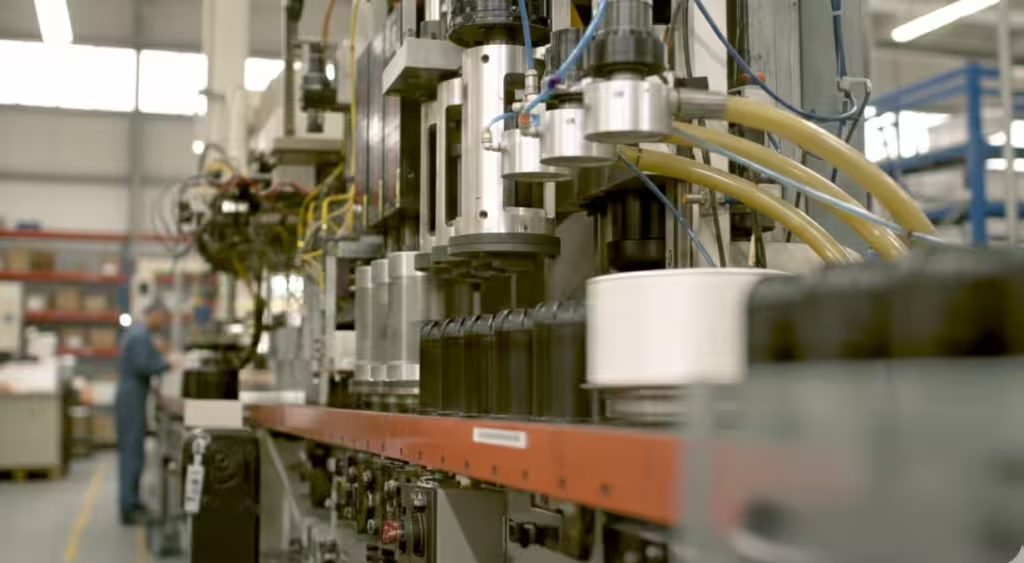
This mechanism is evaluated together with the operating envelope, contamination load, compatibility and required treatment outcome.
This mechanism is evaluated together with the operating envelope, contamination load, compatibility and required treatment outcome.
This mechanism is evaluated together with the operating envelope, contamination load, compatibility and required treatment outcome.
This mechanism is evaluated together with the operating envelope, contamination load, compatibility and required treatment outcome.
OPERATING REALITY
The filter, element, media, vessel or treatment device is only one part of the result. Flow, contaminant loading, pressure, temperature, chemistry, housing condition, drainage, sealing and upstream/downstream process behavior can materially change performance.
Depth Filtration identifies a treatment function. It does not make every product or system inside that category technically interchangeable.
Efficiency, capacity, pressure drop, outlet quality, service interval and compatibility remain tied to validated product or project evidence.
ELIMFILTERS PRODUCT SCOPE
For this Industrial & Process family, the ELIMFILTERS commercial focus is the validated filtration, separation or treatment medium and replaceable element appropriate to the application. Existing housings, vessels, collectors, skids, pumps, fans, ductwork, controls and other plant equipment define interfaces and operating conditions; they are not presented as ELIMFILTERS-manufactured equipment unless separately approved.
APPLICATION ENVIRONMENT
SPECIFICATION & SELECTION
Known project conditions? Send the operating data. Uncertain process or treatment path? Use the engineering review.
HOW THE SYSTEM BEHAVES
Capture suspended solids through the thickness of a porous medium as standalone particulate control or as pretreatment protecting downstream adsorption, membrane, ion-exchange or polishing stages.
Final design depends on the project operating window and the validated configuration selected for the application.
Final design depends on the project operating window and the validated configuration selected for the application.
Final design depends on the project operating window and the validated configuration selected for the application.
Final design depends on the project operating window and the validated configuration selected for the application.
The objective is controlled contamination or conditioning performance at the required process boundary—not simply installation of a familiar filter form.
ENGINEERING GUIDANCE
Particles are captured through the thickness of the porous medium rather than only on one exposed surface. Actual capacity therefore depends on the media structure, particle distribution, feed loading, flow and the qualified element geometry.
A nominal size description does not by itself establish removal efficiency, capacity or downstream cleanliness. Product-specific performance evidence is required for those claims.
Depth filtration can reduce particulate loading before adsorption media, membranes, ion-exchange resin or other sensitive treatment stages, but the correct grade and area depend on the actual feed-water solids burden.
Differential pressure changes with flow, viscosity and loading. Trend interpretation is most useful when operating conditions are comparable and seal or bypass problems have been excluded.
SERVICE & DIAGNOSIS
Repeated breakthrough, pressure-drop problems, unstable outlet quality or short service intervals justify reviewing the whole process boundary.
REQUEST PROCESS REVIEWQUESTIONS FROM THE FIELD
Depth Filtration is the ELIMFILTERS Industrial & Process treatment family for depth filtration. Its role is to capture suspended solids through the thickness of a porous medium as standalone particulate control or as pretreatment protecting downstream adsorption, membrane, ion-exchange or polishing stages.
Depth Filtration belongs to AQUVEXIS™ — Water Treatment Technologies. The platform defines the commercial treatment universe while the family identifies the specific mechanism or treatment function.
No. Industrial & Process selection starts with the operating problem, process conditions, contaminant, flow, pressure, temperature, compatibility requirements and required outcome. Product configuration follows the validated application.
No universal performance value is assigned across the family. Numeric efficiency, capacity, pressure-drop, service-life or outlet-quality claims must remain tied to validated product or project evidence.
No. ELIMFILTERS Industrial & Process is centered on the validated filtration, separation or treatment media and replacement element. Housings, vessels, collectors, skids, pumps, fans, ductwork, controls and other process equipment are application context unless a separate ELIMFILTERS system scope is explicitly approved.
It addresses suspended particulate in industrial water by capturing solids through the thickness of a porous medium. The required element depends on the feed solids, flow, pressure-drop budget and required downstream condition.
No. Removal efficiency, dirt capacity and differential-pressure behavior are product-specific and require validated test evidence rather than a nominal size description alone.
It can be used as standalone particulate control or as pretreatment ahead of adsorption, membrane, ion-exchange or other water-treatment stages that are sensitive to suspended solids.
Rapid restriction can indicate higher-than-expected solids loading, an undersized element area, an unsuitable media grade or a changed feed-water condition. The cause should be confirmed before simply moving to a finer medium.
STANDARDS & TEST GOVERNANCE
The standards below are resolved from the governed ELIMFILTERS Knowledge Center for this treatment family. Applicability remains product-, fluid-, contaminant- and duty-specific.
A listed standard identifies a relevant engineering or verification method. It does not mean every Depth Filtration element is certified, qualified or tested to every listed method. Product claims require the corresponding validated test evidence.
TECHNICAL BASIS
TC-WAT-01 remains the mechanism-level engineering identifier behind the customer-facing family.
No universal efficiency, capacity, micron rating, separation percentage, service-life multiplier or outlet-quality value is assigned across Depth Filtration without validated evidence for the specific product or project.
Approved engineering relationships, operating conditions and diagnostic guidance for Depth Filtration are maintained in the governed ELIMFILTERS Knowledge Center.
WHEN A TECHNICAL REVIEW MAKES SENSE
Repeated failures, unstable process quality, short service intervals, unexpected pressure drop, contamination breakthrough or uncertain compatibility justify reviewing the complete operating environment and treatment architecture.
PLATFORM INTEGRATION
Industrial water treatment organized by contaminant state and treatment mechanism—from suspended-solids control through adsorption, membrane separation, ion exchange and final ionic polishing.
EXPLORE PLATFORMDepth Filtration is resolved inside the AQUVEXIS™ platform. Final selection connects the treatment mechanism to operating conditions, contamination load, compatibility, required outcome and validated product evidence.
APPLICATION SUPPORT
Industrial & Process projects are qualified by duty, operating envelope, contamination mechanism, process risk and system compatibility before the physical solution is selected.
EXPLORE RELATED TECHNOLOGIES