A useful distinction
“Fuel filter” describes a category. The application position tells us what the element is actually being asked to do.
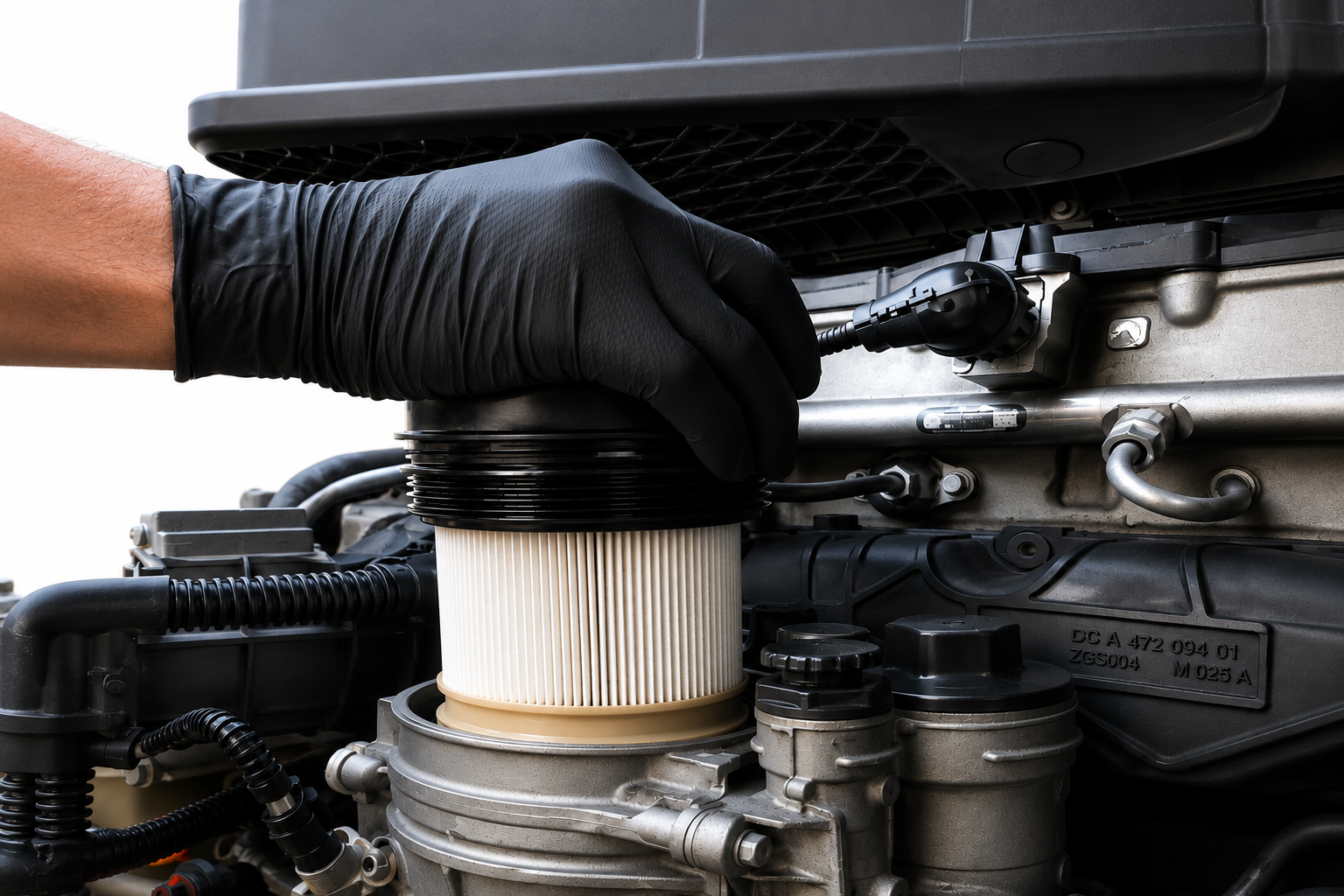

FILTRATION TECHNOLOGY
Primary and secondary spin-on / cartridge fuel filtration
A diesel-fuel filtration architecture for primary, secondary and cartridge fuel-filter applications.
Applied across approved primary, secondary and cartridge diesel-fuel filtration stages upstream of precision pumps and injectors.
DESCRIPTION
SYNTAPORE™ is the ELIMFILTERS architecture for particulate control in primary, secondary and cartridge diesel-fuel filtration stages. Its configuration is selected around efficiency, contaminant-holding capacity, flow and pressure drop for each application.

OPERATING REALITY
Particles that once passed through lower-pressure fuel systems can become damaging at precision pumps and injectors. SYNTAPORE™ is used for approved primary, secondary and cartridge fuel-filter positions where particulate control is the main filtration duty.
“Fuel filter” describes a category. The application position tells us what the element is actually being asked to do.
Tank debris, handling contamination, corrosion products and fine particles can reach the engine unless filtration stages are selected and serviced as a system.
APPLICATION ENVIRONMENT
SPECIFICATION & SELECTION
HOW THE SYSTEM BEHAVES
A primary stage is generally expected to carry a larger contamination burden; downstream filtration protects increasingly sensitive components. Exact efficiency, capacity and flow requirements must follow the approved application rather than a universal micron rule.
Carries the larger upstream particulate load according to the approved fuel-system architecture.
Provides downstream particulate control ahead of increasingly sensitive fuel-system components.
Element selection must match the module, flow path, seal interface and validated application.
High-pressure fuel pumps, precision injectors, metering components and downstream fuel passages.
FUEL-SYSTEM DAMAGE MECHANISMS
Early filter plugging is not only a maintenance inconvenience. When fuel delivery, contamination control or stored-fuel quality deteriorates, the resulting operating condition can expose precision pumps and injectors to abnormal stress or contamination.
Restricted or contaminated fuel supply can increase stress on precision fuel-system components. Repeated low-supply conditions should be diagnosed before they become a pump or system-level event.
Fine abrasive contamination can affect precision injector surfaces and metering behavior. The filtration system must protect downstream components without creating unacceptable flow restriction.
A restricted element can limit fuel delivery when engine demand rises, producing hesitation, RPM loss, reduced power or stalling under heavy work.
Water contamination can promote corrosion and cold-weather operating problems. Applications requiring dedicated water separation should be assigned to the appropriate separation architecture rather than treated as particulate filtration alone.
Stored diesel can support microbial growth at fuel/water interfaces. Biomass and sludge can plug replacement filters rapidly, so recurring early plugging may require tank and fuel-source investigation.
SERVICE & DIAGNOSIS
Repeated short filter intervals, power loss under load or contamination events should trigger a fuel-supply review, not just another filter replacement.
REQUEST FUEL SYSTEM REVIEWQUESTIONS FROM THE FIELD
SYNTAPORE™ is the ELIMFILTERS architecture for particulate control in primary, secondary and cartridge diesel-fuel filtration stages. Its configuration is selected around efficiency, contaminant-holding capacity, fuel flow and pressure drop for the approved application.
The application position determines the duty. A primary stage generally carries more contamination load, while downstream filtration protects increasingly sensitive fuel-system components.
No. Filtration efficiency, contaminant capacity, fuel flow, pressure drop and the approved filtration position must be evaluated together.
SYNTAPORE™ is used for particulate-control fuel-filter positions. Applications requiring dedicated fuel/water separation use HYDROCORE™ for approved standard non-turbine separators or TURBOCORE™ for approved FH/FG turbine-style systems.
Possible causes include dirty bulk fuel, tank debris or corrosion, cold-flow restriction, microbial or sludge contamination, or an incorrect filter position or specification.
Yes. If the element cannot supply the required fuel flow as engine demand rises, the application can exhibit hesitation, reduced RPM, reduced power or stalling. The complete fuel-supply path should be checked.
Precision pumps and injectors are sensitive to contamination and poor fuel supply. Abrasive particles, corrosion products, water and recurring low-supply conditions can contribute to costly fuel-system damage, so repeated symptoms should be treated as a system issue rather than only a filter-replacement issue.
Useful evidence includes engine and equipment identification, filter position, current element reference, housing or module, fuel source, service interval, flow or restriction history and any injector or pump events.
TECHNICAL BASIS
Specific filtration efficiency, contaminant capacity, flow and pressure-drop values should be backed by validated test data for the individual element and approved application.
Primary and secondary diesel-fuel filtration positions can have different requirements. SYNTAPORE™ therefore does not assign one universal micron or efficiency value across the technology.
Dedicated fuel/water separation is split by architecture: HYDROCORE™ governs approved standard non-turbine separators, while TURBOCORE™ governs approved FH/FG turbine-style systems. SYNTAPORE™ remains the particulate-control architecture for approved fuel-filter positions that do not perform separator duty.
Recurring sludge or microbial loading should trigger investigation of storage tanks, water ingress and fuel handling rather than being treated as a filter-only problem.
WHEN A TECHNICAL REVIEW MAKES SENSE
Repeated injector events, short filter intervals, power loss under load or inconsistent fuel quality justify looking beyond individual filters. A useful review starts with filter position, engine and equipment, current element, fuel source, service interval, restriction or fuel-delivery history and any injector or pump events.
SYSTEM INTEGRATION
Fuel Cleanliness Protection controls particulate contamination and water before fuel reaches precision pumps and injectors.
EXPLORE PROTECTION SYSTEMSYNTAPORE™ controls particulate contamination in approved primary, secondary and cartridge positions. HYDROCORE™ provides fuel/water separation for approved standard non-turbine separators, while TURBOCORE™ governs approved FH/FG turbine-style fuel/water separation elsewhere in the Fuel Cleanliness architecture.
APPLICATION SUPPORT
Use Part Search when the application is already known. When the issue is repeated plugging, fuel starvation, contamination, injector exposure or uncertain filtration architecture, use the technical review path.