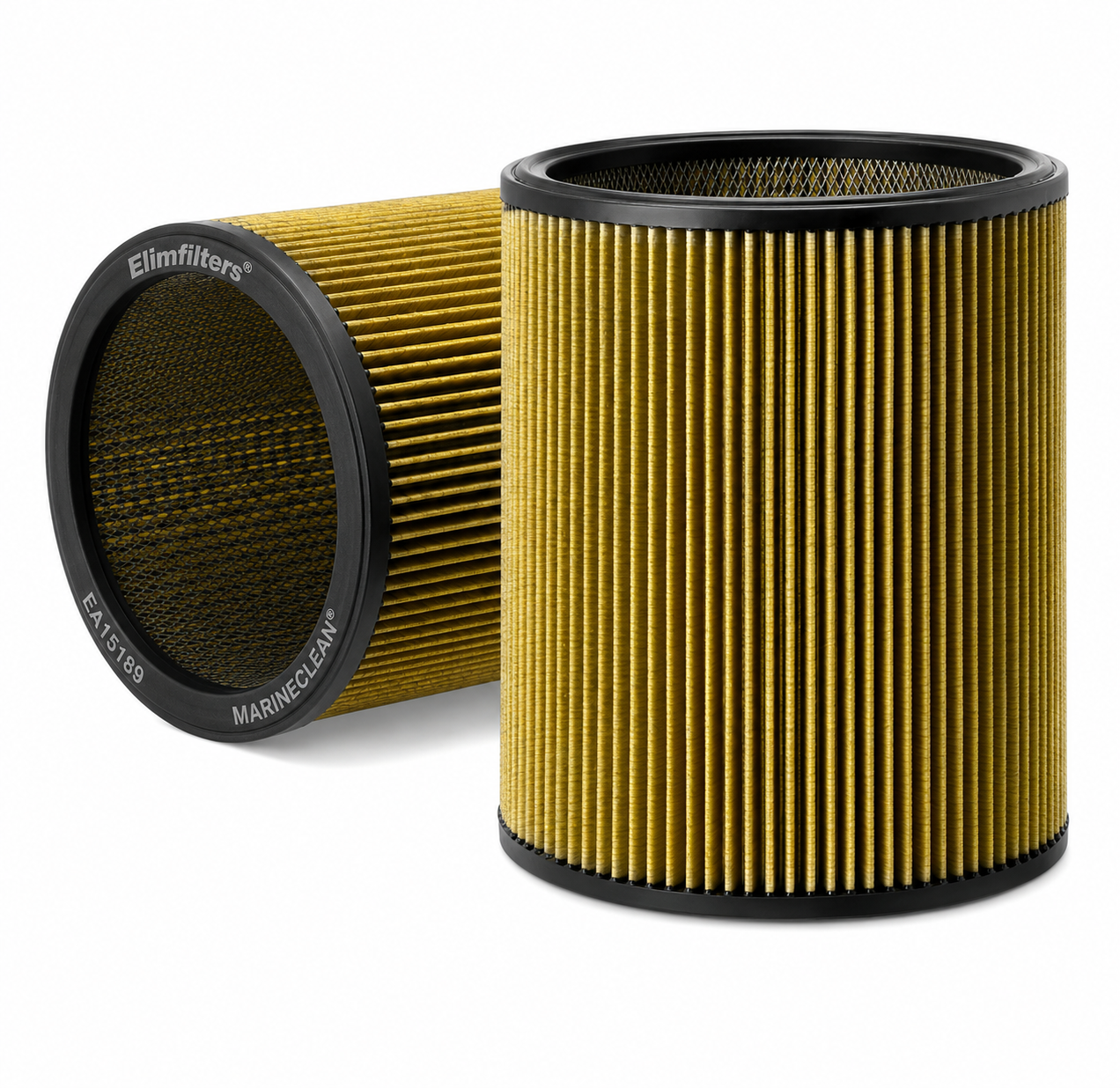
Fuel + Water
Storage, transfer, condensation and marine humidity can introduce water and particulate before fuel reaches the engine.
DIRECT ANSWER
Marine filtration begins with the vessel and contamination path, then resolves fuel-water exposure, protected system, component sensitivity, voyage duty, maintenance access and validated application evidence. The correct filter should not be selected from vessel category or service interval alone.
MARINE PRODUCT LINE
MARINECLEAN™ is the ELIMFILTERS line that groups filtration products for marine applications. It defines the marine product class, not the filtration technology itself. A MARINECLEAN™ product is assigned the ELIMFILTERS technology appropriate to the protected system—for example HYDROCORE™ for fuel/water separation, MACROCORE™ for air intake, NANOFORCE™ for hydraulic protection or SYNTRAX™ for lubrication.
AT-SEA OPERATING REALITY
Marine equipment operates inside a contamination environment that follows the vessel. Fuel quality, humidity, salt exposure and service access can change across storage, port operations and time underway.
Storage, transfer, condensation and marine humidity can introduce water and particulate before fuel reaches the engine.
Salt atmosphere and persistent humidity increase contamination exposure around air paths, housings, service interfaces and onboard equipment.
Steering, deck machinery and auxiliary systems rely on pumps, valves and actuators that require controlled fluid cleanliness.
Once underway, maintenance options narrow. Filtration strategy must account for voyage duration, service windows and port access.
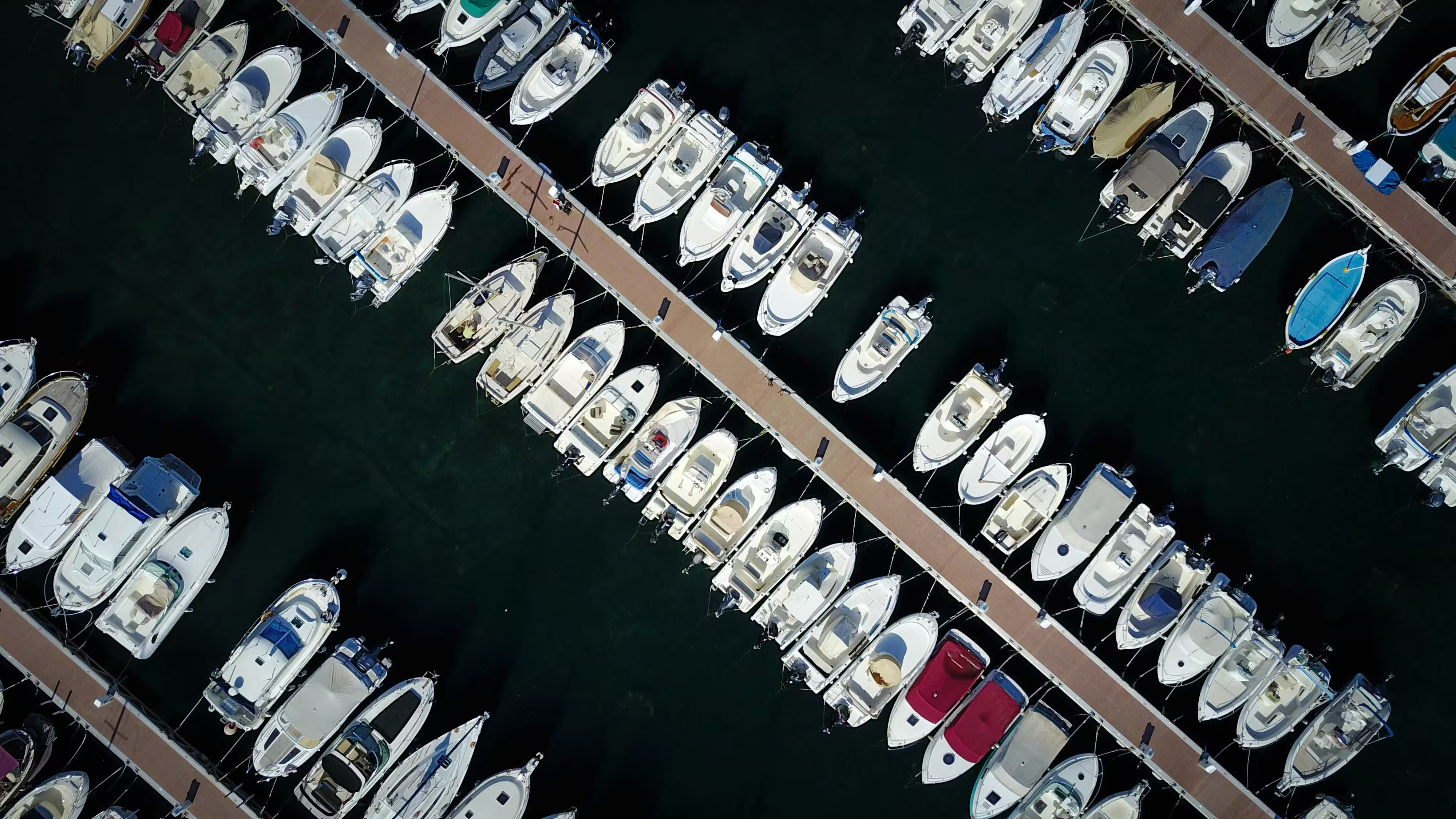
Main propulsion, auxiliary power, steering and deck machinery share the same vessel but not the same contamination mechanism, operating load or service consequence.
CONTAMINATION PATHWAYS
Marine selection should connect each contamination source to the protected system, the appropriate ELIMFILTERS technology and finally to a validated part.
Storage + transfer + condensation + tank breathing
Airborne moisture + salt + particulate around engine intake paths
Ingress + internal wear + service contamination
Wear debris + soot + service ingress
The filtration decision must resolve the vessel, contamination pathway, protected interface, voyage duty, service access and application evidence before a product number is accepted.
At sea, a contamination problem does not wait for the next port call. ELIMFILTERS® marine protection systems are built to handle salt air, humidity, and fuel-water contamination that put engines, deck machinery, and steering systems at risk on every voyage. Our distributor network keeps the correct protection system stocked and available across the ports and service centers vessels actually depend on.
Primary air elements are the main contamination barrier protecting the combustion chamber from particulate ingestion. MACROCORE™ progressive-density media distributes contaminant loading through the full media depth while balancing efficiency, capacity, and restriction.
View Primary Air →VOYAGE CONTINUITY
Marine filtration protects more than a component. It supports propulsion, fuel delivery, steering, deck functions and maintenance predictability across the voyage.
Fuel, air and lubrication cleanliness support the protected interfaces that keep marine engines available under sustained duty.
Water and particulate control matter across storage, transfer and engine supply because contamination can originate before the onboard final filter.
Steering and deck functions depend on clean hydraulic fluid reaching precision pumps, valves and actuators.
A filtration problem at sea can become an operating constraint because service access and replacement options are more limited than on land.
Filtration helps protect injectors, pumps, bearings, turbochargers and hydraulic components whose service consequence can be significant.
A disciplined contamination-control path supports service planning around voyage cycles, port calls and actual operating exposure.
FROM VESSEL CONDITION TO PART
Identify the vessel, engine, steering system, deck machinery or auxiliary equipment.
Define fuel-water risk, salt air, humidity, particulate, hydraulic contamination and storage conditions.
Establish operating hours, engine load, voyage duration, port access and maintenance constraints.
Match the contamination mechanism to fuel, air intake, lubrication or hydraulic protection.
Validate the final filter using OEM reference, dimensions and documented application evidence.
APPLICATION EVIDENCE
Final identification should reconcile the known reference, vessel or engine context, dimensions, protected system and operating conditions. Where evidence is incomplete, the application should remain under review rather than be treated as confirmed.
MARINE FILTRATION QUESTIONS
MARINECLEAN™ is the ELIMFILTERS marine filtration line. It identifies filters developed and organized for marine applications; it is not a filtration-media technology. Products within the MARINECLEAN™ line may use the appropriate ELIMFILTERS technology for the protected system, including HYDROCORE™, MACROCORE™, NANOFORCE™ or SYNTRAX™.
Fuel and water separation, air intake, lubrication and hydraulic filtration are common priorities on marine equipment. The correct priority depends on the vessel, engine, fuel-handling path, hydraulic functions, duty cycle and maintenance access.
Marine fuel can be exposed to storage time, tank breathing, condensation, transfer operations and persistent humidity. The protection strategy should therefore consider the complete fuel path and the need to control both particulate and water before fuel reaches sensitive engine interfaces.
Salt atmosphere and humidity can increase contamination exposure around air-intake paths, housings and service interfaces. Selection should consider the environment, sealing integrity, loading conditions and protected component rather than treating marine duty as equivalent to inland service.
Steering systems, deck machinery and auxiliary hydraulic functions rely on pumps, valves and actuators operating with controlled fluid cleanliness. Contamination can interfere with those precision interfaces and increase service risk.
No. A fixed interval does not describe fuel quality, water exposure, voyage duration, engine load, hydraulic sensitivity, environmental contamination or maintenance access. Service planning should reflect the actual vessel and operating conditions.
Use the vessel or equipment type, engine, protected system, operating environment, fuel-handling conditions, duty cycle, OEM or existing part reference, dimensions when available and validated application evidence.
Yes. If an OEM reference or current filter number is known, Part Search provides the fastest route to cross-reference and application information. For an engineering review, include the vessel, engine, protected system and operating conditions.
HAVE A VESSEL OR CONTAMINATION PROBLEM?
Send the vessel or equipment, engine, protected system, fuel and environmental conditions, duty cycle and any known OEM or filter reference.
IDENTIFY MY MARINE PROTECTION PATH